Marking text
A Pushery\AiContentMarking\MarkedText holds a plain text and the Marking that says how it
came about. Create one where the text comes back from the model:
use Pushery\AiContentMarking\MarkedText;

$description = MarkedText::generated($modelOutput);
$returns = MarkedText::edited($rewrittenPolicy, generator: 'Support Desk', at: now(), model: 'example-writer', operator: 'Example Ltd');
generated() uses the term trainedAlgorithmicMedia, edited() the term
compositeWithTrainedAlgorithmicMedia. The generator, the moment, the model and the operator are
optional, and each ends up in the JSON form as a field of its own: the generator names the system
that produced the text, the model the model behind it, and the operator the company that runs the
system. For any other term, build the marking yourself:
use Pushery\AiContentMarking\DigitalSourceType;
use Pushery\AiContentMarking\MarkedText;
use Pushery\AiContentMarking\Marking;

$text = new MarkedText($proofread, new Marking(DigitalSourceType::AlgorithmicallyEnhanced));
In a page
html() returns the escaped text inside a span that carries the marking as schema.org
microdata. Wrap it in whatever element the page needs:
<h2>{{ $product->name }}</h2>
<p>{{ $description->html() }}</p>
The text becomes the text of a CreativeWork item, and a link element inside the item names
the term:
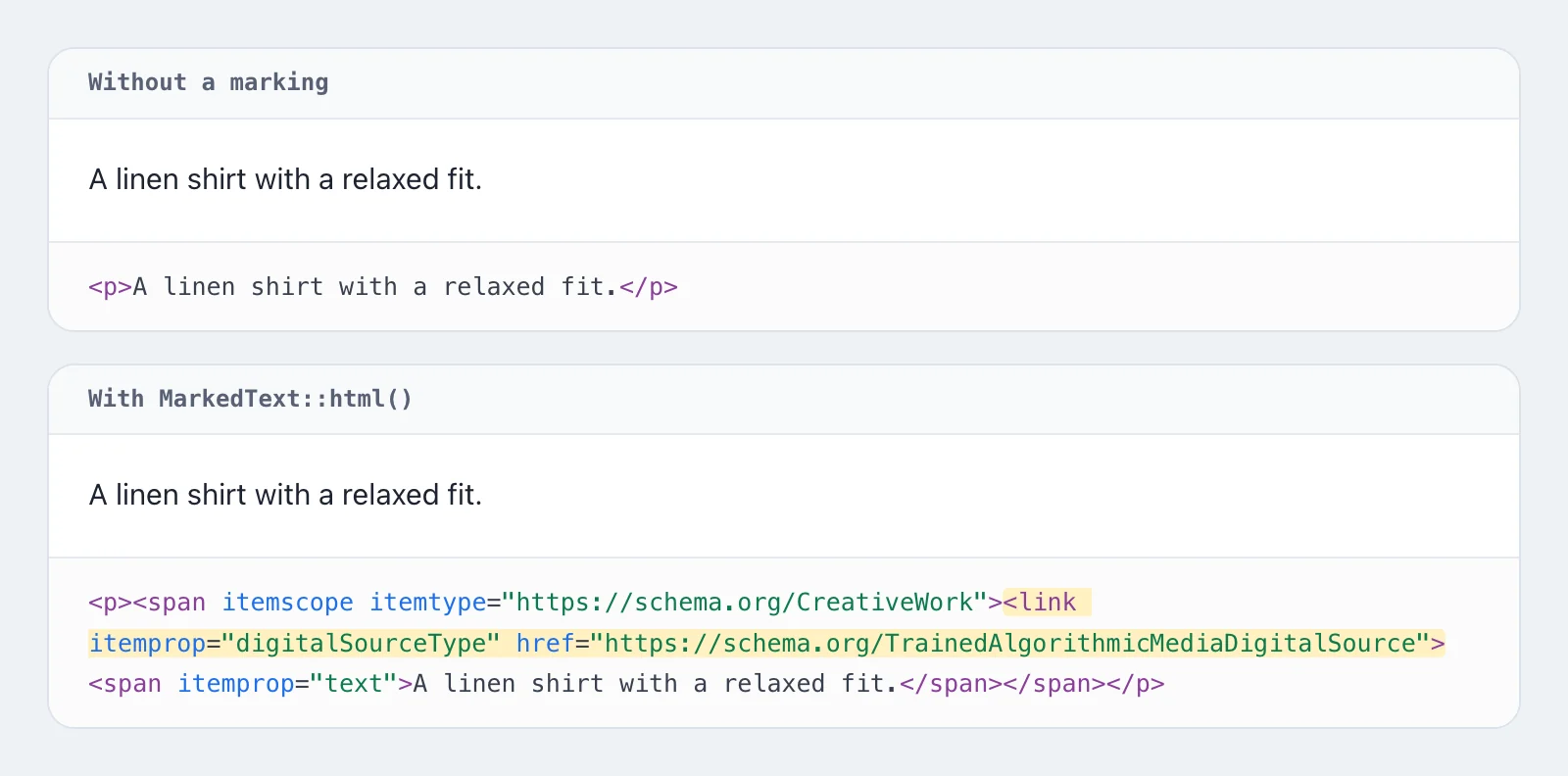
<span itemscope itemtype="https://schema.org/CreativeWork">
  <link itemprop="digitalSourceType" href="https://schema.org/TrainedAlgorithmicMediaDigitalSource">
  <span itemprop="text">A linen shirt with a relaxed fit.</span>
</span>
The term travels in a link because microdata reads a URL value only from href. For the two
terms schema.org has no member for, humanEdits and digitalCreation, the href is the IPTC URI
of the term.
The marked paragraph looks exactly like one without a marking. Only its source differs:
As a plain string
A MarkedText is the plain text wherever a string is expected, and Blade's {{ }} escapes it like
any other string. Nothing marks itself, so a text used where no markup may go stays intact:
<title>{{ $description }}</title>
<meta name="description" content="{{ $description }}">
In JSON
toArray() and json_encode() give the text beside the values of its marking:
{
    "text": "Returns take fourteen days.",
    "marking": {
        "version": 1,
        "digital_source_type": "compositeWithTrainedAlgorithmicMedia",
        "digital_source_type_uri": "http://cv.iptc.org/newscodes/digitalsourcetype/compositeWithTrainedAlgorithmicMedia",
        "generator": "Support Desk",
        "model": "example-writer",
        "operator": "Example Ltd",
        "generated_at": "2026-10-14T21:00:00+00:00"
    }
}
Return the MarkedText from an API resource where the marking should reach the client, and the
plain string where the client expects one. A Marking serializes on its own to the inner object.
version is the version of this shape. It rises when a field changes its meaning or leaves the
shape, not when one is added, so a client can tell a shape it does not know from a value that is
only missing. A marking stored before the field existed reads back with the model and the operator
as null. The mail header field and the XMP of an image carry the term, the generator and the
moment, not the model or the operator.
In the header section of a response
A client that reads a response before its body, such as one that streams the answer, finds the
marking in the response's header section as well. HttpMarking::headers() gives the field:
use Pushery\AiContentMarking\Http\HttpMarking;

return response()->json($answer, 200, HttpMarking::headers($answer->marking));
Digital-Source-Type: http://cv.iptc.org/newscodes/digitalsourcetype/trainedAlgorithmicMedia; generator="Support Desk"
A client that reads the response sees the field before the body:
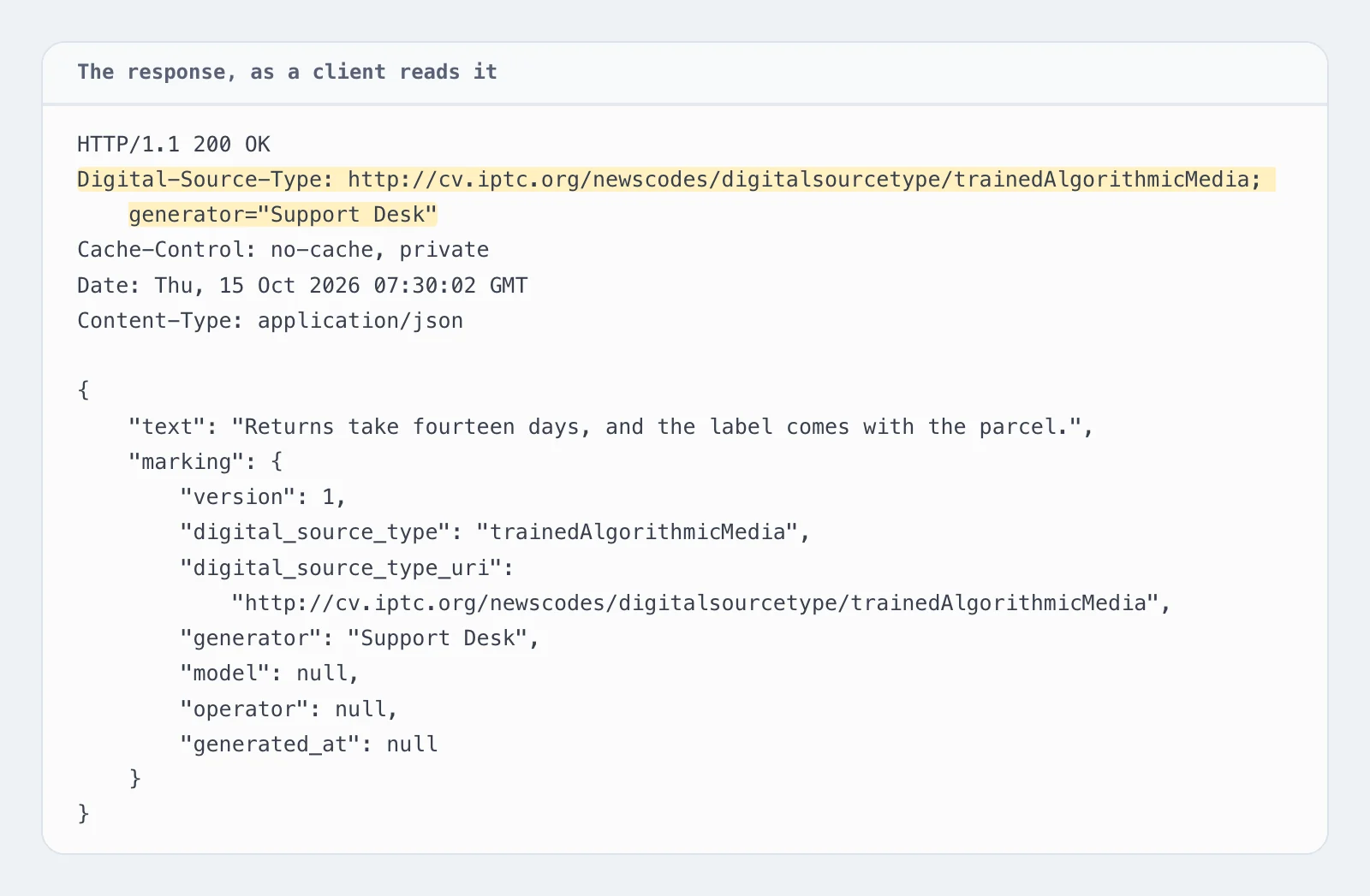
It is the field a mail carries, with the same value: the term's IPTC URI, and the generator and the moment as parameters. A response sends its header section before its body, so set the field from what is known when the response starts. Where a fallback can still change the model, leave the model out of the marking. The marking in the body stays the record of the content.
Rich HTML
A text that already is HTML, such as a description your application stores as sanitized rich
text, goes through Marking::wrap(). It puts the HTML into a div that carries the marking, and
it does not escape it:
{{ $marking->wrap(new \Illuminate\Support\HtmlString($sanitizedDescription)) }}
Pass only HTML that is safe to render. A plain text belongs in MarkedText::html(), which escapes
it.
Storing a marking with a model
Marking is castable. Name it in the casts of a model with a JSON column, and the column stores
exactly what toArray() writes:
use Illuminate\Database\Eloquent\Model;
use Pushery\AiContentMarking\MarkedText;
use Pushery\AiContentMarking\Marking;

final class Product extends Model
{
    protected function casts(): array
    {
        return ['description_marking' => Marking::class];
    }

    public function markedDescription(): MarkedText|string
    {
        return $this->description_marking === null
            ? $this->description
            : new MarkedText($this->description, $this->description_marking);
    }
}
A column can stay null for a text nobody generated. Storing anything but a Marking or null
throws an InvalidArgumentException, and so does reading a column that holds no stored marking.
The cast reads the JSON as your database hands it back, so a PostgreSQL jsonb column, which
reorders the keys, works the same as a MySQL json or a SQLite text column.